The Four Words That Changed How I Practice
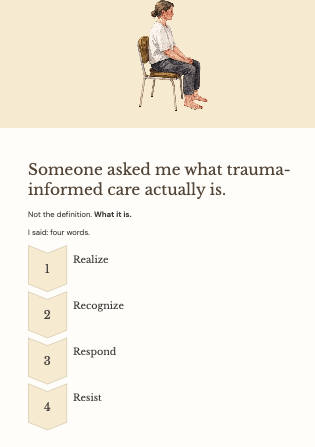
There was a moment early in my career when I thought I understood trauma. I had the textbooks. I had the hours. I had a supervisor who used all the right clinical language, and I had learned to use it too. I could describe the neurobiology. I could explain the ACE study. I could tell you, with some confidence, what trauma does to a person. What I couldn’t tell you — not yet — was what it feels like to sit across from someone who has been failed by every system that was supposed to help them. What it feels like when your office, your clipboard, your very presence triggers something in a nervous system that learned long ago that helpers aren’t safe. I learned that later. The hard way. One session at a time. There’s a framework I return to often now — not because frameworks save us, but because sometimes a good one names what we already know in our bones. The four R’s of trauma-informed care. Realize. Recognize. Respond. Resist. Four words. Simple enough to fit on a sticky note. Complicated enough to spend a career unpacking. Realize is the first movement, and it’s the one most helping professionals skip. To realize is not just to know intellectually that trauma exists. It is to reckon with the fact that trauma is not the exception in the rooms where we work — it is closer to the rule. SAMHSA estimates that the majority of people who seek mental health services have significant trauma histories. Van der Kolk spent decades documenting what the body holds long after the mind has tried to move on. But realize is also personal. It asks something of the helper. Have I reckoned with my own history? Do I know where my nervous system goes when a session gets hard? Have I sat with my own unfinished things — or am I asking clients to do what I haven’t done myself? Thomas Merton wrote that we cannot give what we do not have. I’ve found that true in ways I didn’t expect. The clinician who hasn’t realized the weight they’re carrying walks into the room already at a deficit. Realize isn’t a one-time event. It’s a practice. A return. Recognize is where the work gets specific. To recognize trauma is to see it where it doesn’t always announce itself. Trauma rarely walks in wearing its own name. It walks in wearing resistance. Avoidance. Anger. Shutdown. A client who won’t make eye contact. A parent who shuts down the moment you ask about their childhood. A teenager who would rather blow up a session than feel something they can’t control. Porges’ work on the autonomic nervous system — what he calls Polyvagal Theory, a clinically useful framework even where researchers continue to debate its finer mechanisms — helps us understand that what looks like defiance is often defense. The nervous system doesn’t misbehave. It protects. When we recognize that, our posture in the room shifts entirely. We stop asking why won’t they just… and start asking what happened that made this the safest available response? That question changes everything. Respond is where good intentions either become good care — or don’t. Responding well to trauma is not primarily about technique, though technique matters. It is about attunement. It is about what Bowlby called the secure base — the felt sense that this relationship can hold what I’m carrying without collapsing, without retaliating, without disappearing. In practical terms, it means slowing down. It means asking before assuming. It means offering choice at every possible juncture — not because trauma survivors are fragile, but because so much of trauma is the experience of having no say. Every choice we restore, however small, is a message to the nervous system: something is different here. Respond also means responding to ourselves. Vicarious trauma is not a sign of weakness. It is a sign that we are human, doing human work. The helper who doesn’t tend to their own nervous system eventually has nothing to offer except the appearance of presence. Resist may be the hardest of the four. Resist re-traumatization. In clinical settings, re-traumatization rarely looks dramatic. It doesn’t usually look like harm. It looks like efficiency. Like protocol. Like a form that has to be completed before the session can begin. Like a system that asks a survivor to retell their story to the fifth professional in three years because nobody passed the notes. It looks like a well-meaning helper who pushes too fast because the session is almost over. It looks like a question was asked without permission. A boundary enforced without warmth. A label applied without a relationship. To resist re-traumatization is to be a constant advocate — inside the session, inside the institution, inside the culture of the organizations we serve. It is slow work. Unglamorous work. James 1:4 calls it the work of patience — letting patience have its perfect work, that you may be perfect and complete, lacking nothing. I’ve thought about that verse in clinical terms more than once. Patience, in trauma work, is not passive. It is an active refusal to rush the healing that only the nervous system can time. I don’t offer the four R’s as a destination. I offer them the way I’ve come to hold them — as a compass. Something to return to when the work gets hard and I lose my bearings. Something that names what I already feel in my body when a session goes wrong, or right, or somewhere I didn’t expect. Realize. Recognize. Respond. Resist. Thirty years in, I’m still learning what they cost — and what they give. If you’re building a trauma-informed practice and want tools for the real work, I’ve put together resources specifically for helping professionals at traumatoolbox.com. And if you want to walk this work alongside a community that gets it, the G.R.O.W. Healing Circle is at growheal.me. Two open doors — no pressure, just an invitation.
Use this Trauma-Informed Care Guide in your work and life...
Get Trauma-Informed Certified at TraumaToolbox.com
$10.00